Runtime Governance
Apply policy at the moment of action: Block → Alert → Log, with JIT approvals and scope minimization.
Why Runtime, Not Just Posture
Snapshots don’t stop incidents. SaaS bots, service accounts, and AI agents act continuously—often outside human visibility. Runtime Governance enforces policy before the action completes, turning potential incidents into non-events. It aligns with today’s regulatory expectations (EU AI Act, ISO/IEC 42001) and incident response realities (SEC timeliness), while giving SOC teams control without throttling the business.
How Runtime Governance Works
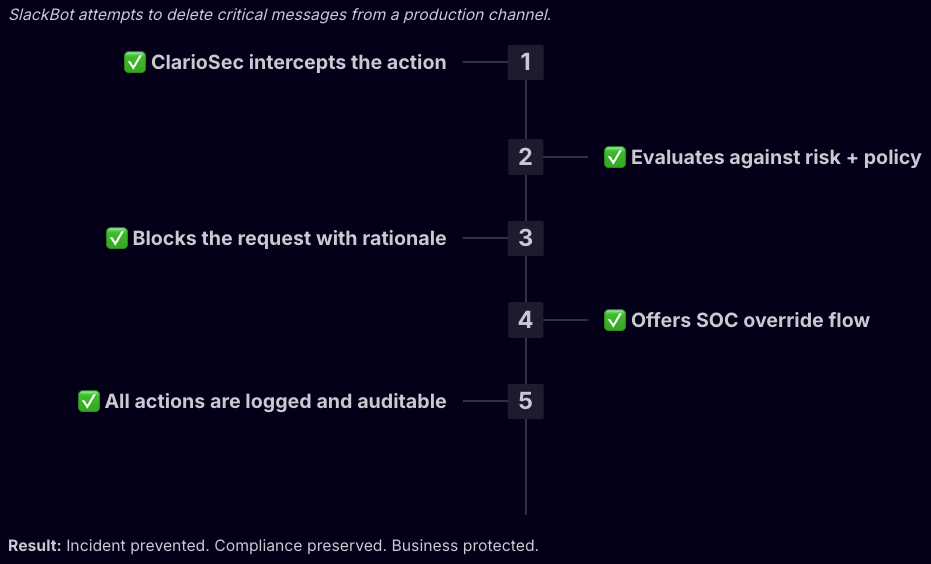
Each agent action is evaluated against policy and mapped controls. Outcomes are explicit and explainable:
- Block — prevent actions that violate policy or controls.
- Alert — require human approval (JIT) for borderline or sensitive actions.
- Log — allow with signed, audit-ready evidence.
Exceptions are governed with expiry and owner. Scope minimization trims over-privilege in the flow, and all outcomes carry natural-language explanations tied to policy IDs and control references.
Connector Rollout & Policy Portability
Start where enforcement delivers outsized value, then expand. We roll out connector support in waves—beginning with Slack, Google Workspace, and GitHub—followed by Microsoft 365/Teams and selected cloud IAM workflows. Because policies are portable, Block/Alert/Log behavior and JIT flows stay consistent across systems, reducing operational friction and training overhead.
Evidence, Overrides, and Auditability
Every decision records what was attempted, which policy and controls applied, the outcome, and why. Overrides capture approver, reason, and expiry. Logs are signed and time-stamped, giving you defensible evidence for auditors, boards, and regulators. Tie enforcement to KPIs—reduced exfil events, minimized scopes, and lower MTTR for agent incidents.
Frequently Asked Questions
What is Runtime Governance?
A policy layer that evaluates each agent action before it executes and applies graduated outcomes: Block → Alert → Log, with support for just-in-time (JIT) approvals, scope minimization, and governed exceptions. Every decision is explainable and mapped to controls for SOC 2, ISO 27001, GDPR, EU AI Act, and ISO/IEC 42001.
How is this different from posture scanning or SSPM?
Posture tools look at configuration snapshots and often alert after the fact. Runtime Governance sits in the action path—enforcing policy at the moment an agent acts. It prevents violations proactively, and records signed evidence you can use for audits.
Which connectors support Runtime Governance today?
We prioritize high-value systems first. Initial rollout targets Slack, Google Workspace, and GitHub, with Microsoft 365/Teams and cloud IAM workflows following. Policies are portable, so outcomes stay consistent across connectors.
Can humans override blocks?
Yes—via governed exceptions. Overrides require an approver, a reason, and an expiry. Every override produces an explainable record and ties back to policy and control IDs.
See ClarioSec in action
Discover hidden agents, drift, and policy risks in minutes.